Language

Reliable BLE Data Transfer: Handling MTU, Throughput & Chunking

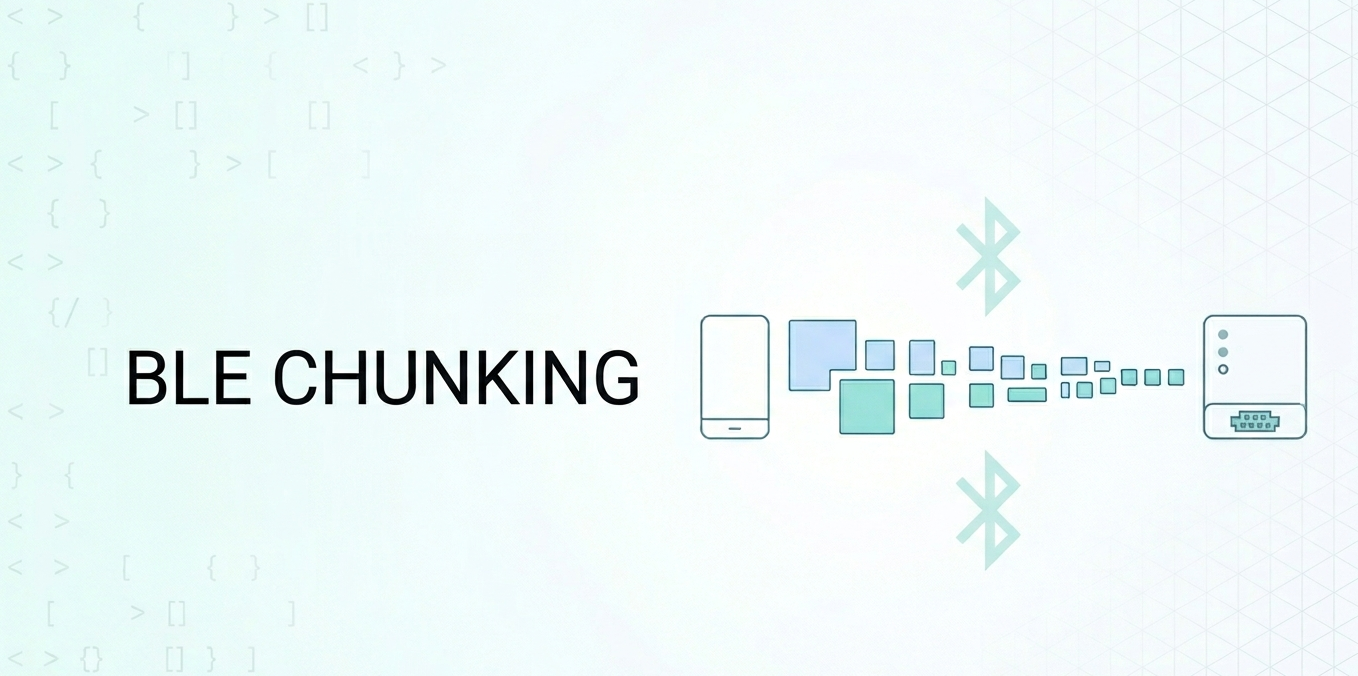
Sooner or later, every BLE developer runs into the same wall: you need to send more than 20 bytes at a time. Maybe it is a firmware image, a batch of sensor readings, or a configuration payload. You fire off a write and… only the first 20 bytes arrive. The rest is silently dropped.

The root of this problem is the MTU (Maximum Transmission Unit) — the maximum number of bytes a single BLE packet can carry. Understanding MTU, knowing how to negotiate it, and building a reliable chunking layer on top of it is essential for any real-world BLE application.

In this article we will cover everything you need to know: what MTU actually is, how to negotiate it on iOS and Android, the difference between write types, how to build a chunking protocol, and how to maximize throughput.

Let’s get started!

Read More

Bluetooth Development: Callback vs Reactive Programming

Building Bluetooth Low Energy applications involves handling numerous asynchronous operations: scanning, connecting, discovering services, reading/writing characteristics, and handling disconnections. The traditional callback-based approach can quickly become unwieldy, leading to what developers call “callback hell.” In this post, we’ll compare the callback approach with reactive programming using RxSwift and RxJava, and explore how reactive patterns can dramatically improve your BLE code.

Read More

Android Bluetooth: A Pitfall

Developing BLE-enabled Android apps is fraught with challenges, especially when it comes to managing concurrent operations. One of the most common pitfalls developers face is the unexpected behavior that occurs when trying to execute BLE operations in rapid succession. In this blog post, we’ll delve into why this happens and how you can overcome it by implementing a custom queuing mechanism for BLE operations.

Read More

Best practice: iOS vs Android Bluetooth

Bluetooth technology has become an integral part of modern mobile applications, enabling seamless wireless communication between devices. Whether it’s for connecting to a wireless headset, transferring files, or interacting with smart home devices, Bluetooth plays a crucial role in enhancing user experience.

For mobile developers, understanding how to implement Bluetooth functionality is essential. In this post, we’ll dive into a detailed comparison of the Bluetooth development frameworks for iOS and Android.

Read More

Series React Native and BLE: Part 2 - Building BLE framework for Android

When it comes to mobile technology, iOS and Android are the two dominant operating systems that power the majority of smartphones and tablets worldwide. As developers, it is essential that we have the knowledge and tools to work with both platforms effectively. This is especially true when it comes to utilizing Bluetooth technology, which is a crucial component of many modern mobile applications.
In part 1 of this tutorial series, we created a BLE (Bluetooth Low Energy) framework that could be connected to the UI using React Native. However, this framework only worked on iOS, which meant that we needed to develop a separate solution for Android.
In part 2 of this tutorial series, we will be focusing on defining a new SDK for Android and linking it to the UI, just as we did on iOS. This will allow us to fully support both operating systems and provide a seamless Bluetooth experience for all users, regardless of their device of choice.

Read More